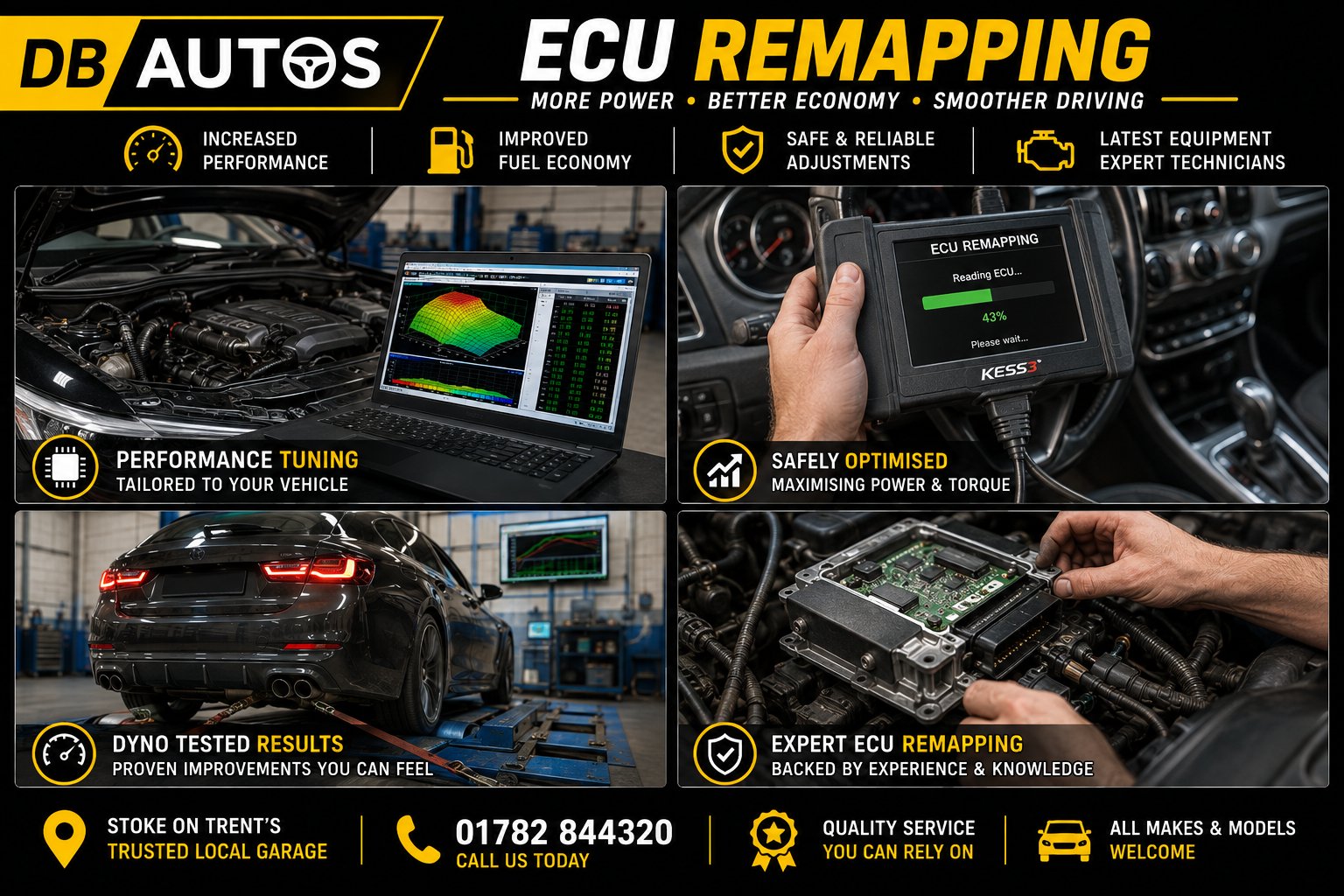
Professional Car & Engine Remapping
Modern vehicles are controlled by sophisticated electronic systems, with the Engine Control Unit (ECU) managing important aspects of engine operation.
Professional ECU remapping modifies selected parameters within the vehicle’s engine-management software to change the way the engine performs.
Depending upon the vehicle and your objectives, remapping can potentially provide:
DB Autos provides professional ECU remapping in Stoke-on-Trent for suitable petrol and diesel vehicles. Rather than making unrealistic promises, the sensible approach is to establish what can realistically be achieved from your particular engine and vehicle.
Your ECU is effectively one of your vehicle’s onboard computers.
Among other things, engine-management software can control parameters associated with:
ECU remapping involves modifying the software calibration to alter how the engine operates. On many modern vehicles this can be carried out electronically through the vehicle’s diagnostic connection, although the exact process depends upon the ECU and vehicle.
Stage 1 remapping is one of the most commonly requested forms of ECU tuning.
It’s generally intended for a standard or largely standard vehicle where the driver wants to improve performance without progressing into substantial hardware modifications.
Depending upon the vehicle, a Stage 1 remap may improve:
Power
Additional engine output can provide stronger acceleration.
Torque
Increased torque can make a particularly noticeable difference during normal road driving.
Throttle Response
The engine can feel more responsive when the accelerator is pressed.
Mid-Range Performance
Stronger mid-range torque can make overtaking and acceleration feel easier.
Driveability
A well-matched calibration can change how responsive and flexible the engine feels.
The achievable result depends entirely upon the engine. Turbocharged engines generally have substantially greater remapping potential than naturally aspirated engines.
Many modern turbocharged petrol engines respond particularly well to ECU tuning.
Depending upon the vehicle, software changes can adjust parameters associated with:
The objective can be stronger acceleration, improved responsiveness and better overall driveability. However, every engine is different. A small naturally aspirated petrol engine isn’t going to suddenly become a fire-breathing monster because somebody plugged a laptop into it. That’s why we’ll look at what can realistically be achieved from the particular vehicle.
Turbo-diesel engines are particularly popular candidates for remapping.
For many drivers, the biggest improvement isn’t necessarily maximum horsepower.
It’s torque.
Additional usable torque can potentially make a diesel feel stronger during:
Turbocharged diesel engines are among the vehicles that can show the most noticeable improvements from appropriate ECU tuning.
You don’t need to be building a track car to appreciate improved performance.
For many drivers, the attraction of an ECU remap is simply making their existing car feel better.
A suitable remap can potentially provide:
Sharper Throttle Response
Less hesitation when you ask the engine for power.
Improved Torque
More pulling power through the usable rev range.
Stronger Acceleration
Particularly noticeable on suitable turbocharged engines.
Better Mid-Range Performance
Useful during everyday driving and overtaking.
Smoother Power Delivery
Depending upon the original calibration and remap.
Remapping can increase horsepower and torque while improving acceleration and throttle response, though the actual result always depends on the vehicle.
Potentially — but this is an area where we’d avoid making silly promises.
An ECU calibration designed around efficiency may improve how efficiently an engine operates under certain driving conditions.
Remapping can potentially improve fuel efficiency by optimising engine operation.
However, actual fuel economy still depends heavily upon:
And there’s an obvious catch: if you remap a car for additional performance and then spend every journey enjoying that extra performance, you’re unlikely to magically use less fuel. Physics remains annoyingly stubborn.
Drivers who regularly tow a caravan or trailer may be particularly interested in torque rather than maximum horsepower.
On suitable vehicles, improved torque delivery can potentially make the engine feel stronger when:
Whether your particular vehicle is suitable should be assessed before remapping.
This is an important section for the DB Autos page because we’re a mechanical garage, not merely somebody selling software.
A remap isn’t a repair.
If your vehicle already has:
those issues should be considered before increasing engine output. Current tuning guidance strongly recommends diagnostic checks before remapping, because existing faults or weaknesses can become more apparent when additional demands are placed on the engine and drivetrain. DB Autos can diagnose mechanical problems as well as providing ECU services.
If the engine-management light is on, something needs investigating.
A remap shouldn’t simply be used to hide an existing mechanical problem.
Depending upon the vehicle, pre-remap assessment can help identify:
If there’s a problem, we’ll advise you before proceeding.
Increasing engine torque doesn’t affect the engine in isolation.
That additional torque has to travel through the:
Clutch → Flywheel → Gearbox → Driveshafts → Wheels
If a clutch is already approaching the end of its life, additional torque can expose the weakness. That’s another reason the mechanical condition of the vehicle matters before tuning. DB Autos also provides clutch replacement and gearbox repair services, so we’re able to look at the vehicle as a complete mechanical system.
Turbocharged engines generally provide greater remapping potential because ECU software can influence turbo boost alongside fuelling, ignition and torque management.
That’s why turbocharged petrol and diesel engines often produce much more noticeable results than naturally aspirated engines.
The key word is appropriate.
More boost isn’t automatically better. The calibration needs to remain suitable for the engine and its components.
In many cases, yes.
ECU remapping can generally be reversed by restoring the ECU to its factory settings.
The exact procedure depends upon the vehicle and ECU.
If returning the car to standard is important to you, discuss this before the remap is carried out.
This needs to be prominent on the page.
An ECU remap is a vehicle modification.
You should contact your insurance provider and tell them about the proposed modification.
Cases have been dealt with where insurers voided policies or rejected claims because modifications weren’t declared.
The sensible order is: speak to your insurer, establish the effect on your cover, then decide whether to remap. Don’t discover the problem after an accident.
Potentially.
If your vehicle is still covered by a manufacturer or aftermarket warranty, modifying its engine software may affect that warranty or particular claims.
Drivers are specifically advised to consider warranty implications before having a vehicle remapped.
If your car is still under warranty, check the terms before proceeding.
ECU remapping doesn’t give a vehicle a free pass around MOT or emissions requirements.
A road-going vehicle still needs to comply with the applicable emissions requirements, and some performance-focused calibrations can alter emissions output.
We would therefore avoid marketing this page around things such as removing emissions-control systems. The objective is professional engine optimisation, not creating MOT problems further down the road.
DB Autos is an established family-run garage in Stoke-on-Trent.
We’re proud to be an AA Approved garage.
DB Autos is also part of the Bosch Approved servicing network.
We’re not looking at software in isolation. We understand the engine, clutch, turbo, gearbox and other components affected by increased performance.
Existing engine-management problems can be investigated before tuning.
Remapping is available for suitable petrol and diesel vehicles.
The objective can be matched to what you actually want from the vehicle.
If we discover a mechanical problem, DB Autos provides servicing, diagnostics and comprehensive vehicle repairs too.
Additional repairs aren’t carried out without your approval.
More torque? Better throttle response? Improved performance? Tell us what you’re hoping to achieve.
We’ll establish whether your vehicle is suitable for remapping and discuss realistic expectations.
Existing mechanical or engine-management problems should be addressed before tuning.
Where suitable, the ECU calibration is modified to achieve the agreed objective.
The vehicle can be checked following the remapping process.
(based on the information currently supplied)
DB Autos has built its business by looking after local motorists year after year.
For us, those reviews matter because they're built through the same things we've always believed in: good workmanship, straightforward advice and treating customers properly.
Read Our Google Reviews →Whether you’re looking for stronger acceleration, additional torque, sharper throttle response or simply better driveability, talk to us about what’s realistically possible with your vehicle.
DB Autos can help with:
ECU Remapping | Car Remapping | Engine Remapping | Stage 1 Remapping | Petrol Remapping | Diesel Remapping | Performance Tuning | Torque Optimisation | Vehicle Diagnostics | Engine Diagnostics
DB Autos
Units 3 & 4 Salem Street
Stoke-on-Trent
ST1 5PR
Fill in the form and we'll get back to you fast — or call or WhatsApp us directly on 01782 844320.
 DB
DB